← Back to work

Rail transit · Operational data / V64

Emergency resources and coordination in rail transit

A product exploration connecting resource discovery, alert assessment, task assignment and field feedback through a shared incident context.

Product and interaction exploration2026Xiaokuang Dong

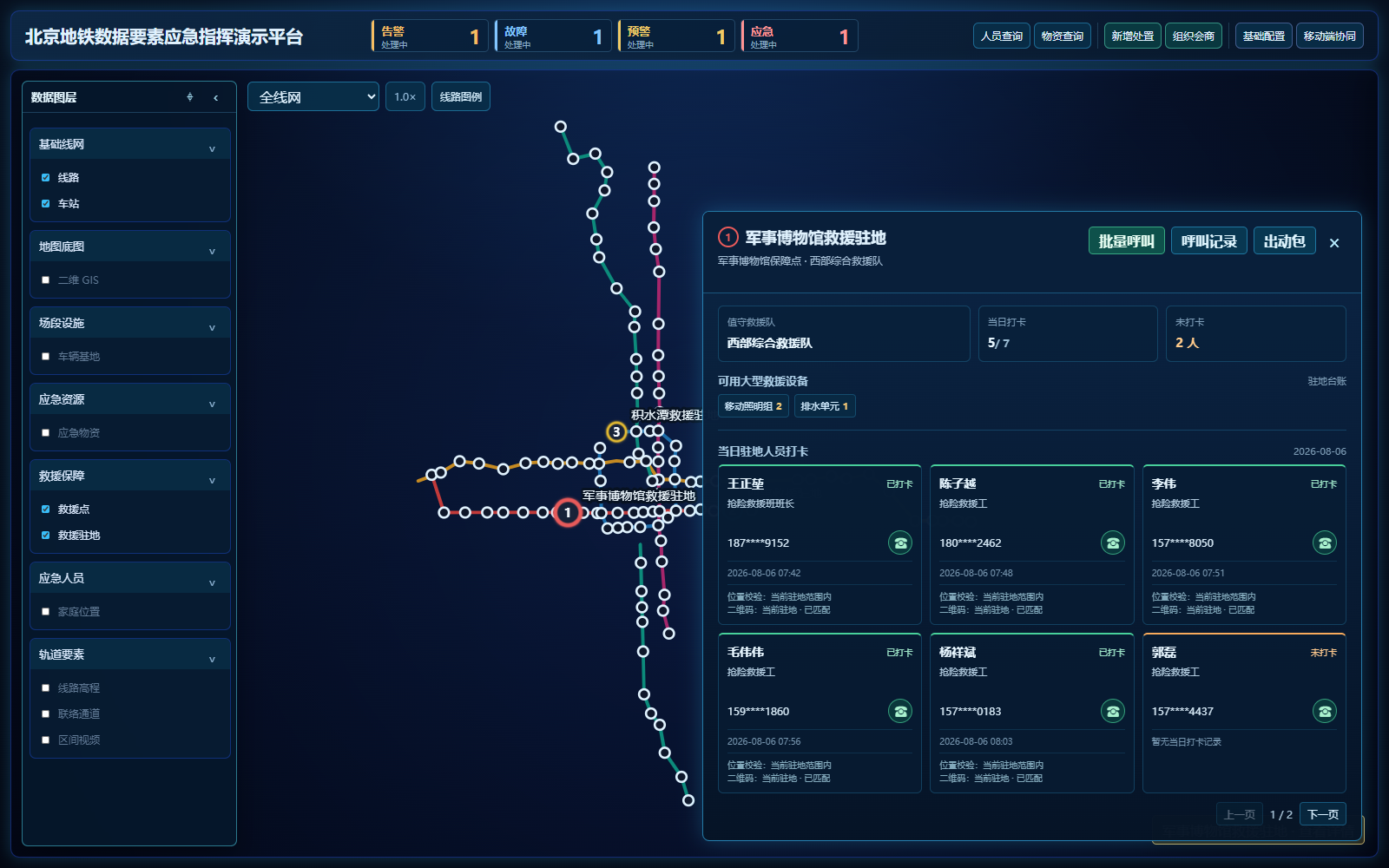
Emergency resources and coordination in rail transit: public demo interface in Chinese
Actual demo interface in Chinese. Data and states are illustrative, not live operations.

THE THINKING / 01

From the problem to a working approach.

When an incident occurs, how does scattered information become coordinated action?

01 / Locate resources

Location gives information a shared context.

Start with a line and station. Bring response bases, personnel and supplies into the same spatial context before arranging a response.

Read the design choice

Design choice: link multiple resource types to the same station.

02 / Coordinate tasks

Assessment turns information into assignments.

Human assessment routes alerts into faults, operational warnings or emergency responses. Match the location and discipline to teams, then confirm assignments.

Read the design choice

Design choice: keep human confirmation and clear responsibility.

03 / Receive feedback

The field keeps changing after dispatch.

Acknowledgement, arrival, field reports and consultation remain connected to the same incident, keeping the control room and field teams aligned.

Read the design choice

Design choice: feedback returns to the original incident.

INCIDENT WORKFLOWILLUSTRATION
RESPONSE BASEFIELD TEAMINCIDENTRESPONSE TASKWORKFLOW ILLUSTRATION / NOT A GEOGRAPHIC MAP

Design choice: link multiple resource types to the same station.

APPROACH & DEMONSTRATION SCOPE

The operational question

During a rail incident, information about locations, people, supplies, equipment and operating conditions is spread across different systems. Responders need a shared context in which to assess that information and organise action.

This English overview accompanies the Chinese case study. The public demo uses Beijing lines 1, 2, 5, 6 and 8 as its geographic background. Resources, personnel, incidents and response times are illustrative, not actual operating arrangements.

The approach

A line or station provides the entry point for finding resources. An alert then passes through human assessment into a fault, an operational warning or an emergency response. The response workflow confirms the incident and location, matches teams and personnel, and reviews assignments before dispatch.

One incident record connects tasks, resources, acknowledgement, arrival, field reports and consultation. Communication remains part of the process, particularly where judgement or confirmation is required.

Explore the demo

The demo interface is in Chinese. Begin with the station 军事博物馆 (Military Museum) to inspect resources. Open 告警 (alerts) to explore assessment, or 新增处置 (new response) to follow the three-step assignment flow. 移动端协同 (field terminal simulation) demonstrates receipt and feedback.

What has and has not been demonstrated

The public version illustrates workflow and interaction. It does not establish field response times, safety performance or measured efficiency gains. Elevation curves, resources and incident data must not be used for engineering or operational decisions.

Read the full Chinese case study.